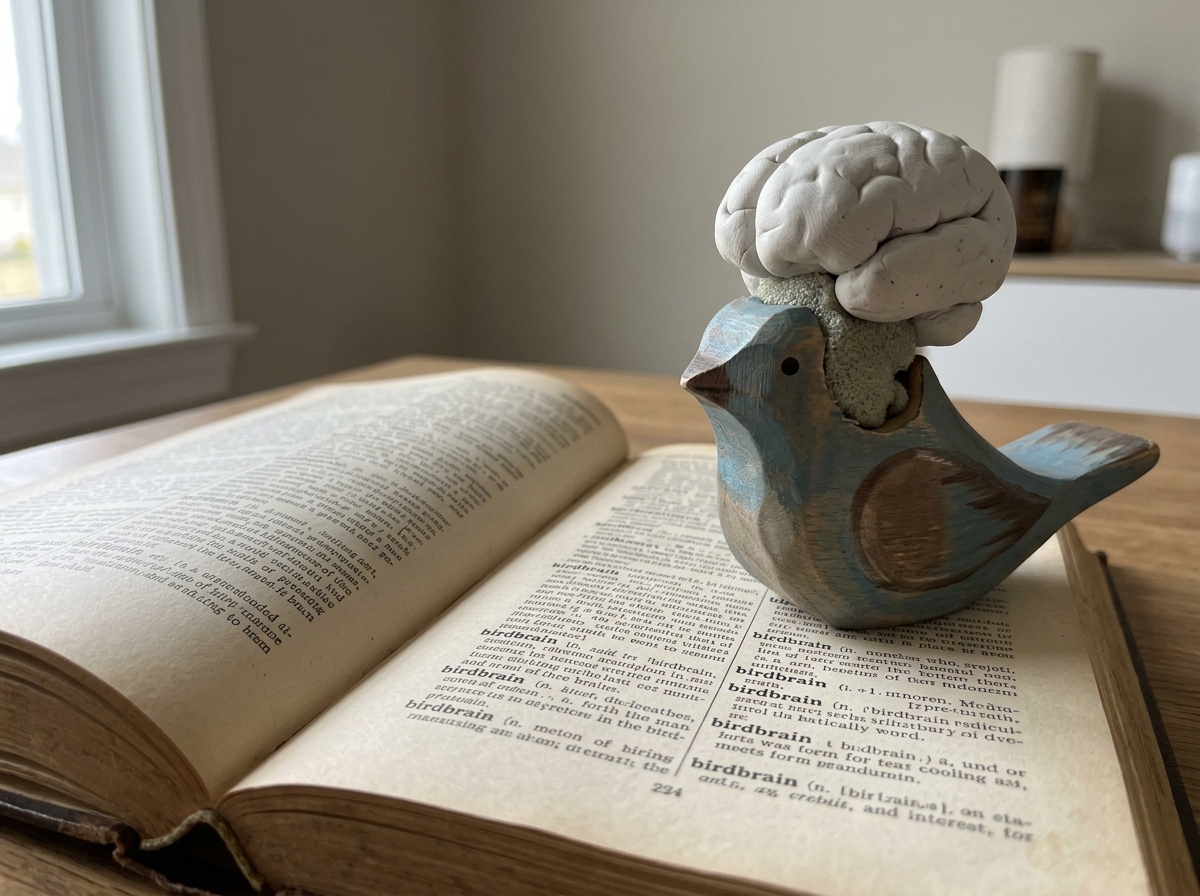
"Bird-brained" means silly, scatterbrained, or not very bright. That's the short answer. All three major dictionaries, Merriam-Webster, Cambridge, and Dictionary.com, define it the same way: an informal adjective used to describe someone (or something they've done) as stupid or silly. If someone called you bird-brained today and you weren't sure whether it was a playful dig or a real insult, this guide will help you figure that out, respond to it, and understand exactly what the phrase does and doesn't mean.
Bird-Brained Meaning: Idiom Explained and How to Respond

Marcus Holloway
23 Mar 2026
What 'bird-brained' actually means in plain English

"Bird-brained" (also written "bird brained" or "birdbrained") is an adjective that describes a person, decision, or idea as foolish, absent-minded, or lacking good judgment. Merriam-Webster lists it simply as "silly or stupid." Cambridge Dictionary echoes that, adding an example sentence: "Frankly, it seems like a birdbrained thing to do." That example is worth noting because it shows the word doesn't have to target a person directly. You can call an idea bird-brained, a plan bird-brained, or a decision bird-brained without necessarily saying the person behind it is unintelligent overall.
The word is informal slang, not clinical or technical language. When someone uses it in everyday conversation, they're drawing on a long-standing cultural shorthand that equates small brains with low intelligence, a stereotype applied to birds and then transferred to people. It carries a mild to moderate sting depending entirely on the context and tone.
Where the phrase comes from and how it's used today
The phrase has been around since at least 1910, according to Etymonline, with Merriam-Webster placing the documented "birdbrain" noun form at 1916. That makes it over a century old, which explains why it feels so embedded in everyday English. It originated in the United States as informal slang, built from a simple (and scientifically shaky) idea: birds have small brains, therefore they must be unintelligent, therefore calling someone a bird-brain implies they don't think very well.
In practice today, the phrase shows up in two very different tones. The first is a genuine insult, where someone uses it to dismiss or belittle another person's intelligence or judgment. The second is affectionate teasing, where it's used between friends or family members to poke fun at a forgetful or scatterbrained moment without real malice. The words are identical in both cases; the difference is entirely in delivery, relationship, and context. That ambiguity is exactly why it's worth knowing how to read the situation and respond accordingly.
Spelling variants: bird-brained, bird brained, or birdbrained?
All three spellings refer to the same word and the same meaning. Merriam-Webster uses the closed compound "birdbrained" as its primary headword but also recognizes the hyphenated form "bird-brained." Dictionary.com uses the hyphenated version as its main entry. The spaced form "bird brained" shows up in casual writing and online use. None of them is wrong. If you're writing formally, the hyphenated "bird-brained" is the most widely recognized standard form.
Related slang and bird-themed insults you'll hear alongside it
"Bird-brained" doesn't exist in isolation. It sits in a cluster of bird-themed language that people use to comment on intelligence, behavior, and personality. Some of these are insults, some are neutral observations, and a few have flipped into compliments depending on the context.
- Bird brain (noun): The person themselves, not just their behavior. "Don't be such a bird brain" targets the individual more directly than the adjective form.
- Birdbrained (one word): The most compact spelling, same meaning as bird-brained.
- Featherheaded: An older, less common variant implying the same lightness of thought.
- Scatterbrained: A close synonym that doesn't use bird imagery but carries the same implication of disorganized, forgetful thinking.
- Airhead: Another informal synonym, slightly more modern in tone, implying someone's head is full of nothing substantial.
- Ditzy: A softer, often gendered variant implying a lack of focus or seriousness rather than outright stupidity.
- Flighty: Technically a bird metaphor too (birds flying away), used to describe someone who's unreliable or unable to commit to anything.
If you're exploring this phrase alongside related terms, it's worth knowing there are also deeper dives into what "bird brain" means as a standalone concept, including cultural uses and even how the phrase appears in music and media. Those threads are connected to this one but deserve their own unpacking. bird brain meaning. bird brain meaning song
What it really implies about someone's thinking or behavior
At its core, "bird-brained" implies one or more of these things about a person or action: impulsiveness, forgetfulness, poor judgment, or a general lack of careful thought. It doesn't carry a precise or clinical meaning, which is part of what makes it useful as slang and also potentially unfair as a label.
The tone matters enormously here. Between close friends, "you're so bird-brained" after someone locks their keys in the car can be warm and funny. In a workplace, the same phrase aimed at a colleague's proposal is dismissive and potentially humiliating. In an argument, it's an escalation. Because the word blurs the line between "forgetful" and "stupid," it's worth being careful about applying it even jokingly, since the person on the receiving end may hear only the "stupid" half.
It's also worth noting that the word doesn't imply anything specific about why someone acted a certain way. It's a blanket judgment, not a diagnosis. Someone might make a "bird-brained" decision because they were tired, distracted, overwhelmed, or simply rushed. Using the label flattens all of that context into a single, unflattering stamp.
How to respond if someone calls you bird-brained

Your best first move is almost always to ask for clarification rather than immediately reacting. Something as simple as "What do you mean by that?" or "How do you mean?" accomplishes two things: it slows the moment down, and it puts the responsibility on the other person to explain themselves. If it was friendly teasing, they'll say so. If it was meant as a genuine put-down, naming that shifts the dynamic without escalating it.
- Pause before reacting. A quick emotional response often makes things worse, especially if the intent was to provoke one.
- Ask for clarification. "What do you mean by bird-brained?" is a calm, effective way to make someone own their words.
- Name what happened if it felt disrespectful. "I don't appreciate being called that" is a boundary, not an attack.
- Decide whether to continue the conversation. If someone doubles down after you've said it bothered you, it's completely reasonable to step back from the discussion entirely.
- Don't internalize it. A slang insult about intelligence is not a professional evaluation or a factual statement about who you are.
If the comment came from someone in a position of authority, like a manager or teacher, the approach is similar but the stakes are higher. Documenting what was said and when is a practical step if the behavior is part of a pattern. A single casual comment in a clearly joking context is different from a repeated pattern of dismissiveness dressed up as teasing.
What to do if you want to use the phrase yourself
If you're tempted to call someone bird-brained, it's worth pausing to think about whether "forgetful," "scattered," "hasty," or "impulsive" would be more accurate and less likely to land as a global judgment on the person's intelligence. Those words say what you actually mean without the baggage. If the relationship is close enough that the joke is clearly safe, that's a judgment call. But in professional or unfamiliar settings, it's a word that can sting more than you intend.
Myths worth clearing up: what 'bird-brained' is not
Because this site covers bird symbolism, cultural meaning, and spiritual interpretation, it's worth addressing a question that comes up occasionally: does "bird-brained" carry any literal, spiritual, or symbolic bird meaning? The short answer is no. It has nothing to do with bird symbolism, bird omens, or spiritual messages. It is purely a figurative slang expression about human behavior.
Myth 1: It's a literal statement about bird intelligence
The insult is built on an outdated stereotype: that birds have small brains and are therefore dim-witted. Modern science has thoroughly dismantled this. Research covered by National Geographic, Scientific American, and University College Oxford has shown that birds, particularly corvids like crows and ravens, and parrots, demonstrate problem-solving, tool use, long-term memory, and even something resembling planning. Calling a crow bird-brained would, ironically, be a compliment if we were being accurate. The phrase stuck around because it sounds clever and has cultural momentum, not because it reflects real avian biology.
Myth 2: It's a spiritual or symbolic bird reference
If you found this phrase while exploring bird symbolism or spiritual bird meanings, the word "bird-brained" is not part of that conversation. It's English-language slang, nothing more. Birds carry rich symbolic meaning across cultures, from freedom and divine messengers to omens and spiritual guides. None of that symbolic tradition connects to this idiom. The phrase is rooted in informal American English and has no spiritual, folkloric, or cultural symbolism attached to it.
Myth 3: It's an ableist clinical term
"Bird-brained" is not a clinical diagnosis and it's not formally categorized as ableist language, though it's worth recognizing that intelligence-based insults as a category can perpetuate harmful attitudes about cognitive ability. The word is slang with a derogatory edge, and treating it as casual neutral feedback is missing its intent. It's meant to diminish, even when it's lobbed with a smile.
Quick reference: everything in one place
| Question | Answer |
|---|---|
| What does bird-brained mean? | Silly, stupid, scatterbrained, or showing poor judgment (informal adjective) |
| How old is the phrase? | Attested from around 1910, with documented use by 1916 |
| Is it always an insult? | Depends on tone: can be affectionate teasing between friends or a genuine put-down |
| Does spelling matter? | No: bird-brained, bird brained, and birdbrained all mean the same thing |
| Does it have spiritual meaning? | No: it is purely figurative English slang with no symbolic or spiritual connection |
| Is the bird-brain stereotype accurate? | No: birds like crows and parrots are highly intelligent; the stereotype is outdated |
| How should you respond to it? | Ask for clarification, name your boundary if needed, and don't internalize it as fact |
FAQ
How should I respond if I think someone is joking, but I’m not sure?
If it sounds like a joke, answer by mirroring the intent and adding context, for example, “I was tired, not dumb,” or “True, I forgot, can we laugh and move on?” If it doesn’t feel safe, choose a boundary line like, “Don’t label my intelligence. What’s the actual issue?”
What’s the best way to handle “bird-brained” in an email or text?
In writing, the safest move is to avoid repeating the phrase and instead describe the specific behavior, such as “That was a rushed decision,” or “I think we missed a step.” If you must address it, quote minimally: “You said ‘bird-brained,’ and I’d prefer we discuss the process, not my intelligence.”
Can “bird-brained” be aimed at a decision or idea, not a person?
Yes. You can use “bird-brained” to criticize an idea or plan without attacking the person, for example, “That approach is bird-brained,” meaning the plan lacks good judgment. Still, the term often lands as a judgment, so in professional settings prefer “poorly thought out” or “not well planned.”
Does calling someone “bird-brained” mean you’re diagnosing them with something?
It usually does not. “Bird-brained” implies low judgment or forgetfulness, but it does not identify a specific cause like ADHD, anxiety, or a learning disability. If the situation involves possible neurodivergence, better language is “I need a clearer process” or “Let’s make a plan that supports focus,” not an intelligence label.
What should I do if a boss or teacher uses the phrase?
If the comment comes from a manager, teacher, or someone with power over you, treat it as unprofessional even if it’s framed lightly. Keep it job-focused: “Please give specific feedback on the work, not personal comments.” If it repeats, save examples and ask for a meeting to clarify expectations.
Are “birdbrained” and “bird-brained” different words or different meanings?
The spelling varies, but meaning does not. “Birdbrained,” “bird-brained,” and “bird brained” all point to the same slang idea. In formal writing, “bird-brained” is the most recognizable, but many style guides would still prefer alternatives like “scatterbrained” or “not well thought out.”
Is it ever acceptable to use “bird-brained” with friends?
Yes, especially where intelligence insults can be interpreted as hostile. If you are close with someone, check impact before escalating: “I know you meant it as a joke, but that one stung.” In unfamiliar relationships, assume it could be taken as derogatory and avoid it.
What are better alternatives than “bird-brained” when I mean “you forgot” or “you messed up”?
A common mistake is using it as a shorthand for “you forgot” or “you made a mistake,” which turns a solvable moment into an identity insult. If your goal is accountability, try “That slipped my mind” or “Let’s build a checklist,” which addresses the behavior without branding someone’s intelligence.
What if I’m repeatedly hearing “bird-brained” after mistakes?
If you hear it repeatedly, it is often less about one mistake and more about dismissiveness. A practical next step is to bring the conversation back to actions: “Let’s talk about what went wrong and how we improve next time.” Then set a boundary if the tone returns.
Next Article
Bird Brain Meaning: Idiom Definition, Origins, and Usage
Meaning and origins of bird brain slang, how to use it, tone, and how to respond politely to avoid offense.